
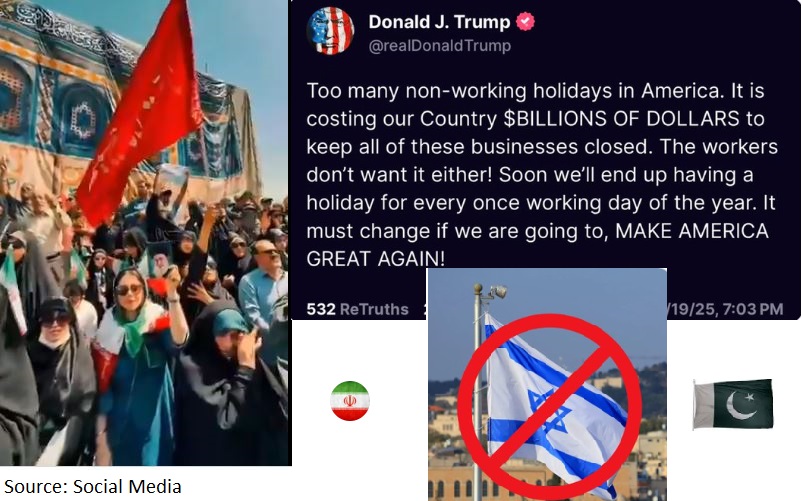
The U.S. war with Iran was planned by CIA and MI6 and shelfed since 1979
The U.S. war with Iran has long been a shelved contingency, originally conceived by the CIA and MI6 after the 1979 Islamic Revolution wrested Iran’s oil wealth from Western control. With the fall of the Shah and the rise of Khomeini, Washington and London lost a key geopolitical asset. Since then, the blueprint for confrontation has lingered in the background—refined, deferred, but never discarded.
Understanding Israel’s Hegemonic Origins: A Deeper Look into the Balfour Declaration
Understanding Israel’s global impact requires examining the motives behind its creation. While the official narrative holds that Israel was established on a humanitarian basis to provide refuge for persecuted Jews, its foundation was, in fact, shaped to end that very persecution. For this to be achieved, powerful elites deemed it necessary to establish Israel as a hegemonic state.
The Balfour Declaration of 1917, which signaled British support for a Jewish homeland in Palestine, remains opaque in its origins. A 1922 memorandum by William Ormsby-Gore prepared for Winston Churchill confirmed the absence of transparent policy-making:
“Available papers provide little insight into how the policy was initially formulated. Negotiations [… were] mainly oral and private notes and memoranda, of which the scantiest records are available, even if more exists.” Palestine Papers: 1917-1922: Seeds of Conflict, by Doreen Ingrams.
These vague origins point to decisions made in closed circles, and those circles included key members of The Milner Group—notably Lord Alfred Milner and Lionel Walter Rothschild. Both were active Zionists and part of a political elite with global ambitions. As Dr. Carroll Quigley wrote in The Anglo-American Establishment,
“The Milner Group… had as its goal nothing less than to rule the world.”
It was Lord Milner who initially drafted the Balfour Declaration. Later, “The Earl of Balfour [U.K. Foreign Secretary], the late Sir Mark Sykes, and Messrs Weizmann and Sokolow [Chief London representative of the Zionist Organization] were involved.” The final declaration was addressed to Lionel Walter Rothschild, the face of Zionism in Britain.
Taken together, this network of elite actors—Zionists, imperialists, and financiers—did not merely aim to protect Jewish lives but to install a strategic client state. Israel was created to ensure the persecution of Jews was stopped. It was only possible to create Israel as a hegemon state. The creation of Israel fulfilled both a humanitarian cause and a geopolitical design. That design, rooted in the ambitions of the Milner Group, was to ensure control over a region critical to global energy routes and imperial influence.
Seen in this light, Israel was not just a homeland—it was a hegemon, deliberately positioned to serve as an anchor for Western dominance in the Middle East.
Trump’s Change of Mind
A president elected on a platform of ending wars and avoiding new conflicts has now reversed course on foreign policy. There are several reasons why Trump has come to own Israel’s war with Iran. In my X post, here, I wrote that Trump is scared. If he resists, the Milner Group—still present today in the form of the Council on Foreign Relations (CFR) and the broader establishment—has allegedly threatened his family.
Another reason lies in figures like J.D. Vance and Marco Rubio, who had previously expressed disdain for Trump, but are now part of his circle. This suggests that Trump was told who would make up his cabinet. Under internal pressure, Trump had little choice but to pursue Netanyahu’s war.
Israel—or more precisely, Netanyahu—does not need to ask for permission. The United States is obligated to safeguard Israel, and Netanyahu knows he is not confronting Iran alone. Trump may have also been swayed by Israel’s textbook-style decapitation strikes on Iran’s leadership and its ability to evade Iranian air defenses to hit strategic targets.
However, Trump appears misinformed about the true effectiveness of Israel’s airstrikes. Government insiders and former officials, including Philip Gordon, believe that Israel has successfully paralyzed Iran and are optimistic about the prospects of regime change. Yet, this group provides little substantive argument to support their optimism.
In contrast, analysts such as Scott Ritter, Larry Johnson, Alastair Crooke, and Professor John Mearsheimer argue that Israel is running low on missiles, and that neither the Iron Dome nor THAAD provide foolproof protection against Iran’s missile capabilities. The core of their argument is Iran’s overwhelming stockpile and retaliatory capacity.
If Trump were to choose the path of diplomacy and sign a deal with Iran, it would not negate the earlier arguments for why he appeared to embrace Israel’s war. Instead, it would indicate that pragmatism prevailed, aiming to curb Iran’s alleged pursuit of nuclear weapons through negotiation rather than conflict.
If we keep the Syrian model in mind, is it plausible that Iran could economically be weakened and a regime change to follow?
Israel has systematically weakened Iran’s regional proxies through regime disruption and leadership decapitation, exerting sustained strategic pressure on Tehran. By degrading Hamas’s authority in Gaza, orchestrating regime change that dismantled Iran’s military presence in Syria, and assassinating key Hezbollah figures, Israel has severed the indirect threads that underpin Iran’s broader strategic defense—the hollowed out Iran’s forward command structure.
Unlike Iran, Syria fragmented into warring factions. Iran, despite protests, has a more cohesive central state, powerful security services (IRGC), and stronger national institutions. Iran is geographically vast, with diversified borders and deeper economic and security buffers than Syria had. Iran has a more diversified industrial base and deep oil and gas reserves (despite sanctions), giving it a limited but real capacity to survive economic war longer than Syria.
It is too early in the conflict to estimate economic sanctions and kinetic punitive measures paving the way for an Iran increasingly vulnerable to internal economic and political fragmentation. Additionally, the unknown—Pakistan.
A Questionable Winning Strategy If It Involves Pakistan
A Questionable Winning Strategy If It Involves Pakistan
On June 14, 2025, President Trump held a working lunch with Pakistan Army Chief Gen. Asim Munir and ISI Director Gen. Asim Malik. The purpose was to assess their motives for supporting the war against Iran. Specifically, to determine whether their involvement stemmed from genuine alignment with U.S. interests or from self-serving ambitions, all while weighing their track record of human rights abuses with the tacit approval of Biden and Trump’s administration.
Trump’s two-week window to decide on attacking Iran may hinge on whether Pakistan re-engages and offers its support. This reflects a strategic failure—once again relying on Pakistan to “do more.” The generals in question, shaped by humble beginnings and questionable loyalties, remain fundamentally untrustworthy.
Yet Trump appears cornered, compelled to adopt Israel’s war as his own. It’s a war that would demand American boots on the ground for any hope of regime change—risking another 20-year quagmire, and turning the MAGA vision into a defeated illusion.
Israel A Tarnished Name
The world is eager to shun Israel. Evidence emerged when students on campus protested against Gaza genocide. Pakistan has more than terrorist group. The global Jihad will begin. Expect them to turn on Israel.
Iran Has Entered A Violent Phase
In the event of regime change, power could shift to factions less constrained by the current leadership’s religious fatwa against nuclear weapons, increasing the risk of a more aggressive nuclear posture. The Islamic Revolutionary Guard Corps (IRGC) and affiliated hardliners have at times questioned the restraint shown by Supreme Leader Ali Khamenei regarding nuclear weapons.
Reza Pahlavi (son of the last Shah), living in exile is weak and cannot stop the people demand acquire WMD in the wake of Israel’s aggression.
Mujahedin-e Khalq are the former Marxist-Islamist group, now vehemently anti-clerical and anti-regime. Highly mistrust in the society lobbies in the West. Their nuclear view is unknown officially, but given their militant posture, unlikely to uphold the fatwa if it conflicts with their objectives.
Other groups, including rogue actors and separatist factions, could further destabilize Iran in the event of regime collapse. However, the IRGC is likely to overpower and suppress these rivals, positioning itself as the dominant force. Governing Iran in such a fractured environment would remain deeply complex and volatile for the United States.
Unconfirmed sources suggest that the Supreme Leader has granted full authority to the IRGC, effectively placing Iran under religious military rule. This shift means the IRGC now holds decision-making power across all domains. In the event of Supreme Leader Ali Khamenei’s assassination, there would be no power vacuum—the IRGC would maintain control without interruption.
This is a war between Islam and the United States, and Trump is waging it without the support of traditional allies. In doing so, he violates a core military axiom: never go to war alone. The Waterloo of the United States.
Conclusion:
Once the broader Muslim world is fully armed and awakened, those opportunistic Pakistani officers who once aligned themselves with Trump will face a reckoning. The weapons of resistance will ultimately be turned toward figures like Asim Munir, whose betrayal will not be forgotten. His fall will be a symbol of the collapse of a failed military elite.
There is always a glimmer of hope for Imran Khan in moments shaped by divine force. A new alignment may emerge—Pakistan, Iran, and Afghanistan drawing closer in shared purpose. As for India, its deep involvement in covert operations alongside Mossad within Iran may signal that its own reckoning is near.
Bio: Mian Hameed is the author of MANIPULATION OF THE MIND: Our Children and Our Policy at Peril. He is a student of the U.S. and South Asia foreign policy. My articles do not present the conventional thoughts of the mainstream media. To read my work, click the Home link below.